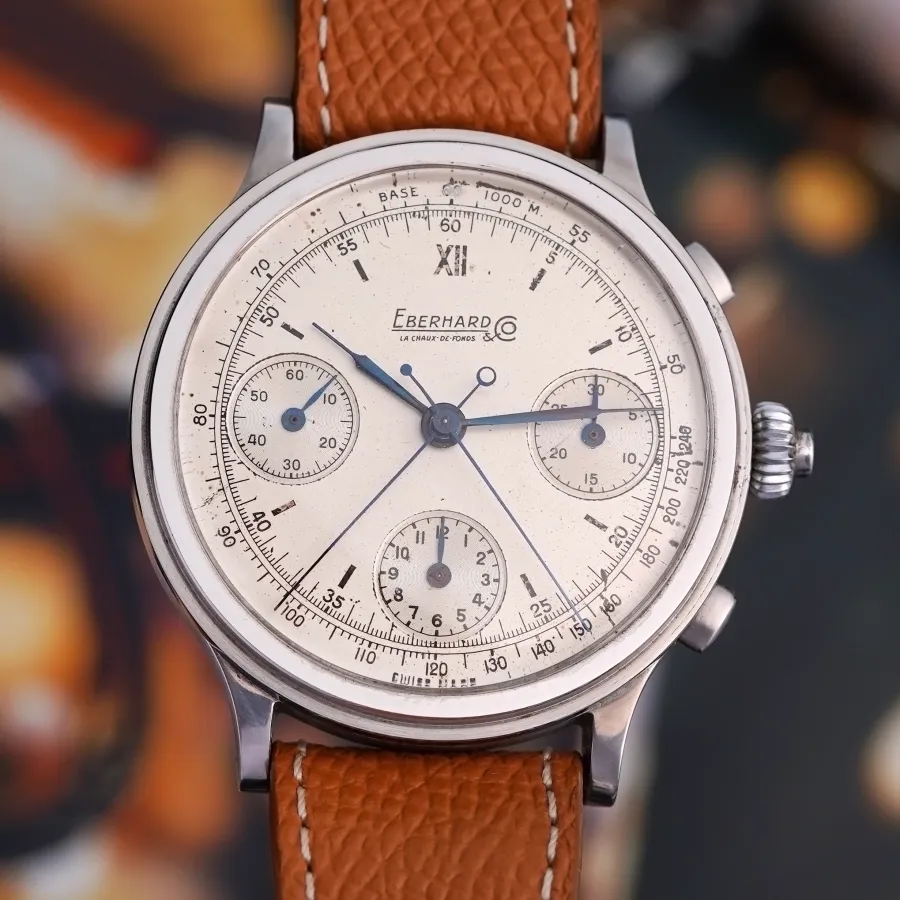
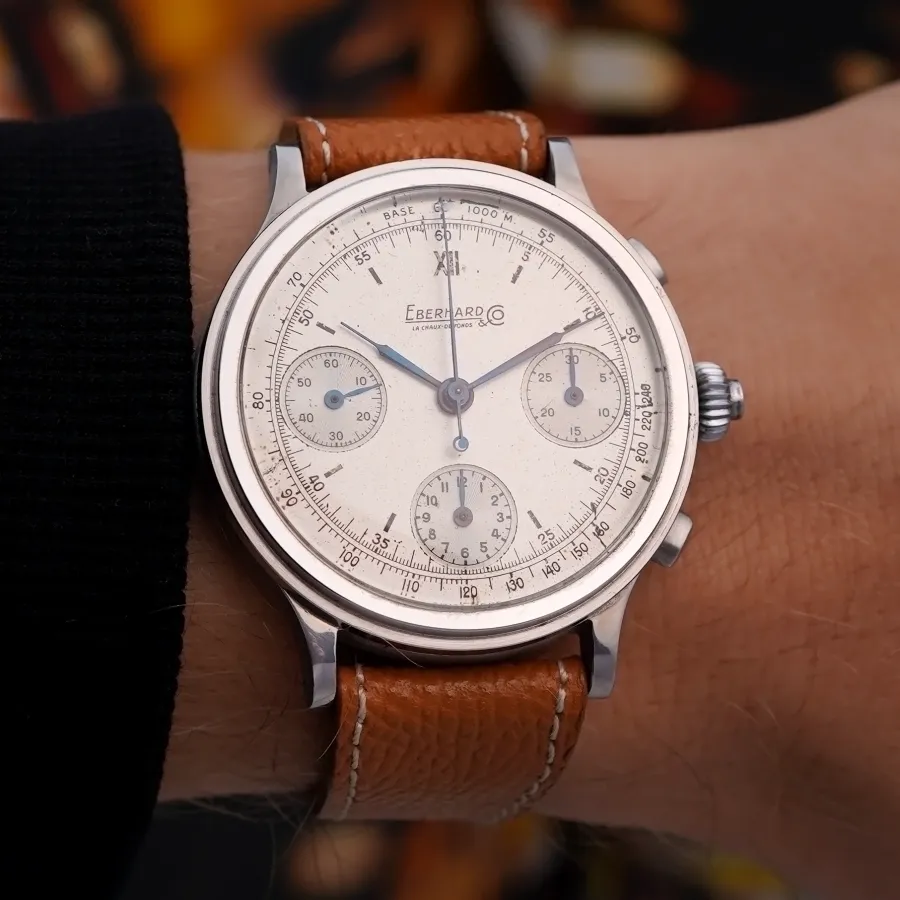
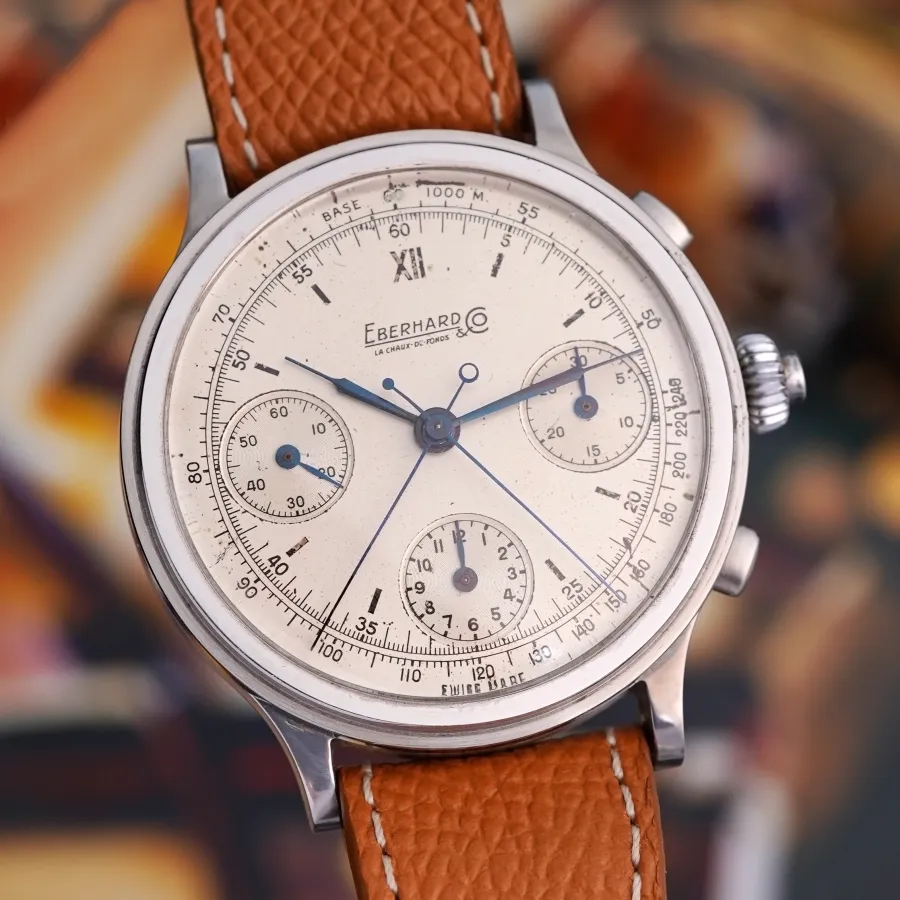
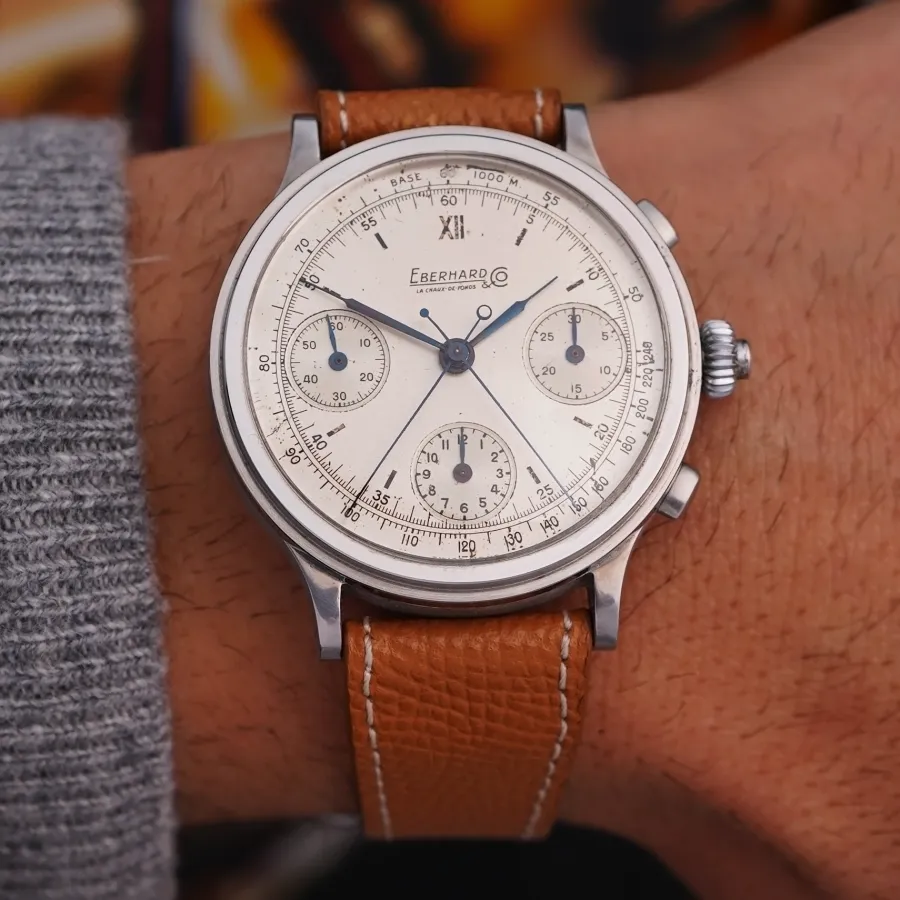
Eberhard Pre Extra Fort Split Seconds Chronograph White Dial
ultra rare 40 mm rattrapante chronograph - Cal. 1600 - ca. 1940
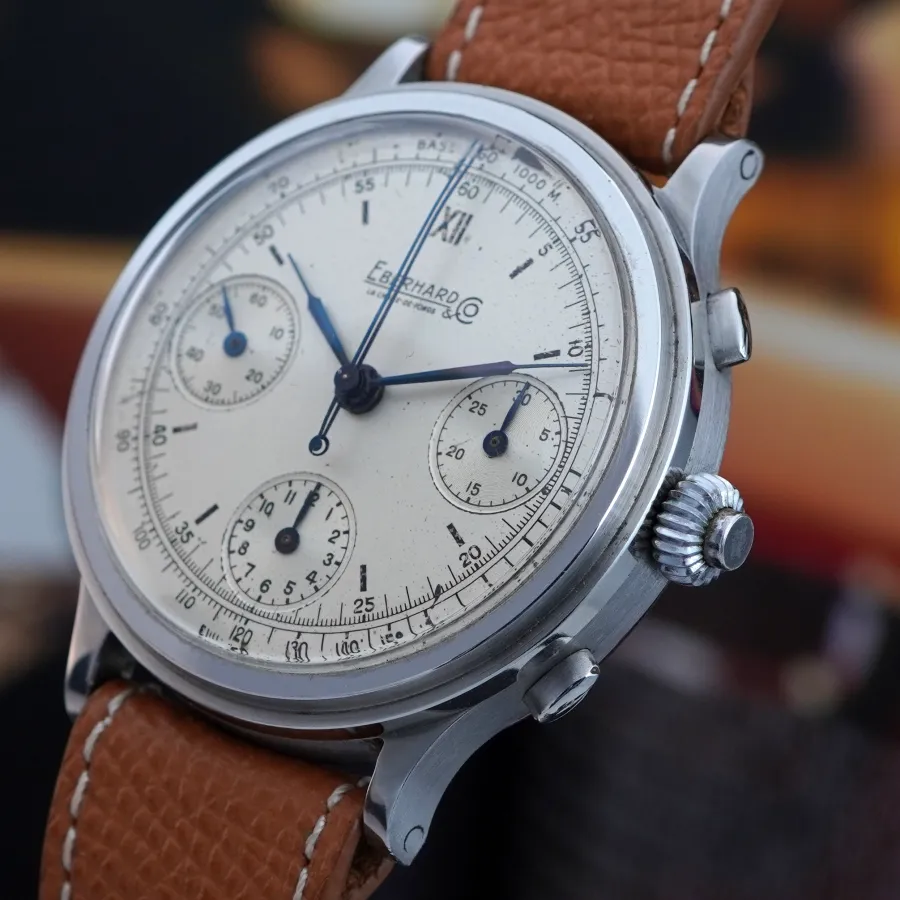
The split-seconds chronograph represents one of the most fascinating mechanical developments of the classical chronograph. When started, the two superimposed central chronograph hands initially move together and appear almost as a single hand. By activating the rattrapante function, one of the two hands can be stopped while the other continues running. This makes it possible, for example, to record intermediate times or two events occurring in quick succession. Once the time has been read, the stopped split-seconds hand catches up with the continuing chronograph hand – hence the French term “Rattrapante”, derived from rattraper, meaning “to catch up”. Another distinctive feature of this early Eberhard construction is the characteristic slider at 4 o’clock: when pushed upwards, it stops the running chronograph. At the same time, the slider serves as a safety mechanism, as the chronograph pushers are also locked in this position, preventing the chronograph from being accidentally operated or altered.
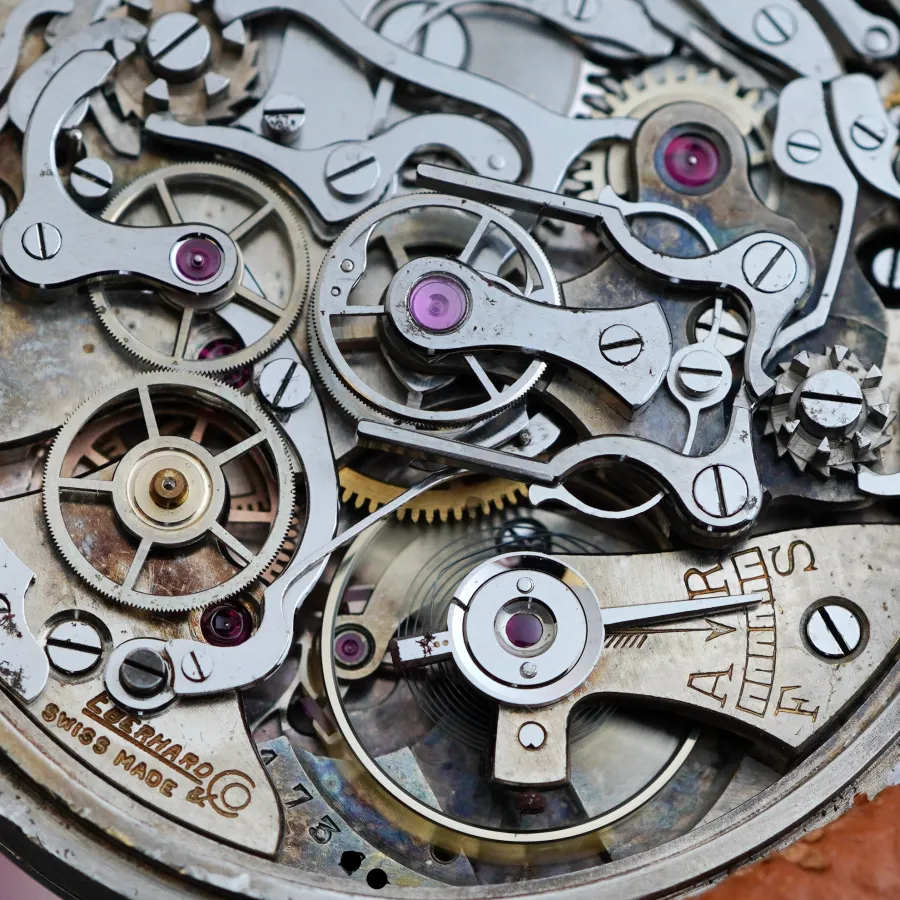
Around 1940, such a construction was technically extraordinarily sophisticated. While a conventional chronograph already requires the complex interaction of numerous levers, wheels and springs, the split-seconds mechanism adds another level of mechanical complexity. Eberhard was among the manufacturers to incorporate this demanding technology into wristwatches at an early stage. This example is powered by the large manually wound Calibre 1600, which was used in various configurations in early Eberhard chronographs of this generation.
At 40 mm in diameter, the stainless steel case was exceptionally large for its time. Men’s watches of the late 1930s and early 1940s were generally considerably smaller, meaning that this Eberhard must already have had an unusual presence when it was first produced. Today, these dimensions are part of its particular appeal: despite being more than eight decades old, the chronograph feels neither small nor antiquated on the wrist, but instead has proportions that appear surprisingly modern. The long lugs, narrow bezel and expansive dial further reinforce this impression.
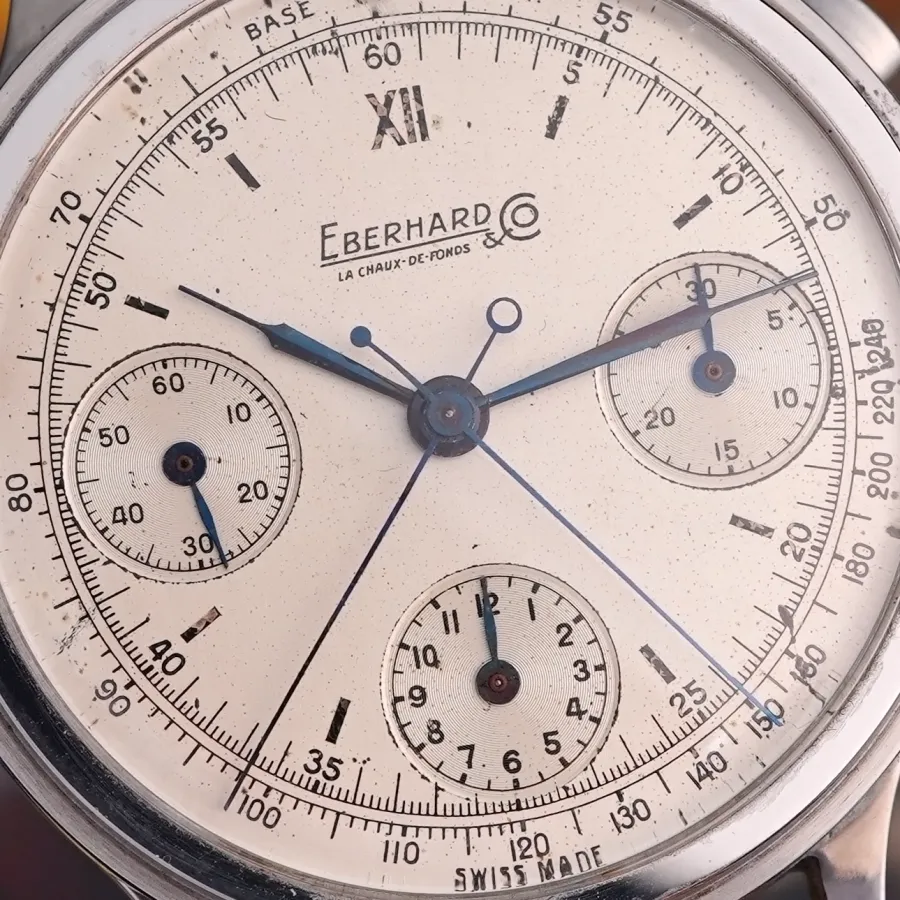
The original white dial has developed an even and completely authentic ageing over more than 80 years. Subtle traces of age and the gently matured surface tell the story of its history without detracting from the clarity of the design. Three subsidiary dials structure the layout, while the fine outer tachymeter scale marked “BASE 1000 M.” extends to the very edge. The historic Eberhard & Co. signature with “LA CHAUX-DE-FONDS” and the blued hands complete the characteristic appearance of the period. Particularly fascinating, of course, are the two central chronograph hands: when positioned one above the other, they give little indication at first glance of the mechanical complexity concealed beneath them.
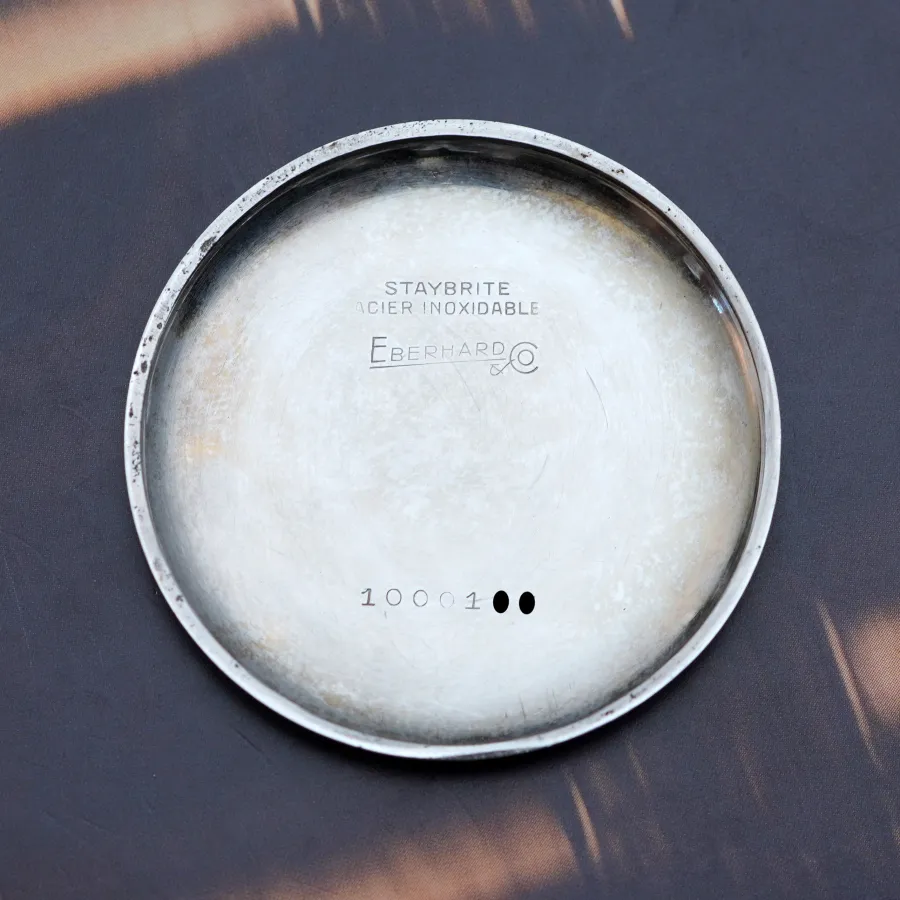
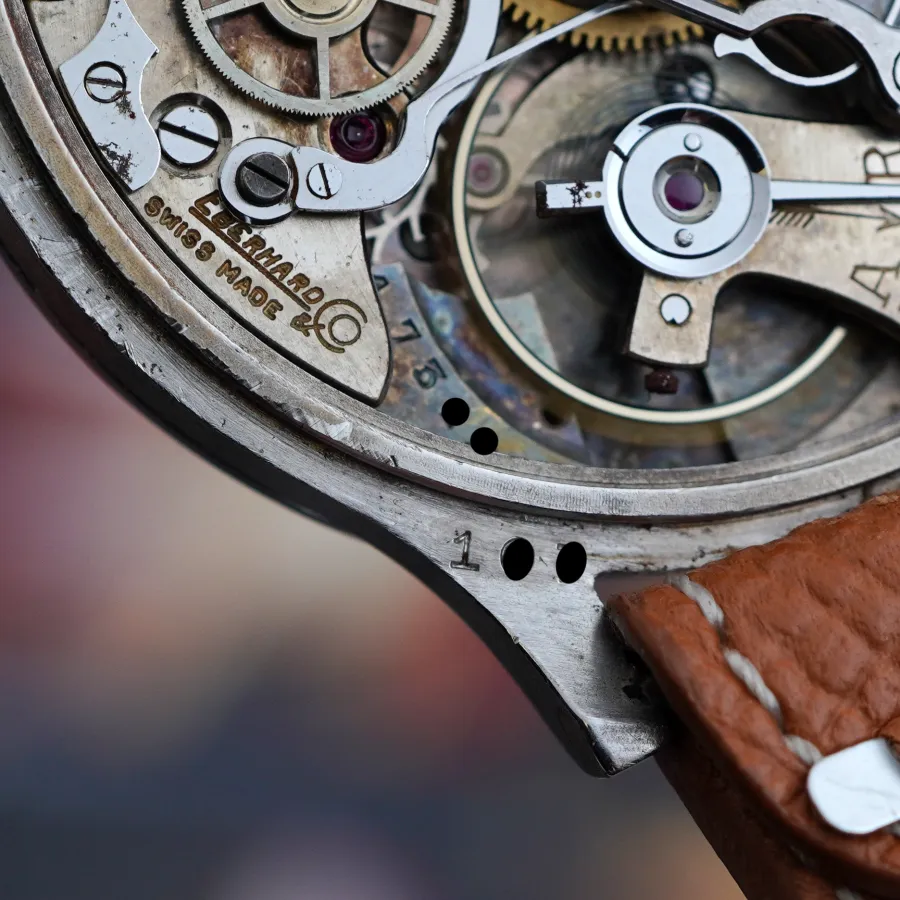
The designation “Pre Extra Fort” is used today by collectors for these early oversized Eberhard chronographs that preceded the later and celebrated Extra Fort line. This example comes from a particularly early series: the case number is in the 1.000.xxx range, while Calibre 1600 bears a movement number in the 17.xxx range. These numbers place the watch convincingly within the early period of these exceptional chronographs around 1940.
Ultimately, it is the combination of two characteristics that makes this Eberhard so special: 40 mm at a time when a case of this size was an absolute exception, and a rattrapante complication that was extremely rare even among high-grade chronographs. Together with the authentically aged white dial and the large historic manually wound movement, the result is a chronograph that impressively embodies both the technical ambition and the courage to embrace exceptional dimensions of its era – and which, more than 80 years later, still possesses a remarkable presence.
Condition Description
Dial: original white dial with even, authentic ageing - very harmonious patina developed over more than 80 years - original blued hands - signed: "EBERHARD & CO. – LA CHAUX-DE-FONDS SWISS MADE".
Case: original 40 mm stainless steel case - light, age-appropriate signs of wear and use - case number in the 1.000.xxx range on the inside of the caseback - the three stamped digits on the reverse of one lug correspond exactly to the last three digits of the case number inside the caseback, confirming that the case components belong together - inside of the caseback signed "EBERHARD & CO", "STAYBRITE" and "ACIER INOXYDABLE" - width between the lugs: 20mm.
Movement: original Eberhard manually wound Calibre 1600 with split-seconds/rattrapante complication - movement number 17.xxx - chronograph and split-seconds functions fully operational - timegrapher readings: −22 seconds/day, amplitude: 269°, beat error: 0.1 ms.
Serial number: 1000xxx
Int.Exe.: 5963146
Manufacturer: Eberhard
Model: Pre Extra Fort
Functions: rattrapante - small running second - hour and minute - tachymeter - 12 hour totalizer - 30 minutes counter - chronograph
Intricacies: split second
Material: Stainless steel
Dial: white
Watch glass: acrylic crystal
Bracelet: leather
Diameter: 40mm
Caliber: Eberhard 1600
Movement type: manual wind
Year of Manufacture: 1940
Overall condition: 9 - has rarely been worn - top condition
All shipments are insured and available worldwide, with shipping and returns covered by us. If you are not completely satisfied with your purchase, you may return the watch in its original condition within 14 days of receipt, no questions asked.
Protecting your privacy is important to us. Your personal information, including address, login and payment details, is securely transmitted using encryption to ensure it is safe from unauthorized access.
Your trust is our commitment - ensuring a safe and seamless shopping experience.
Get to know us better - learn more about our team and our global references.
All watches are located in our office in Munich, Germany. You are very welcome to visit us.
Make an appointment